AI SaaS Vs Traditional SaaS

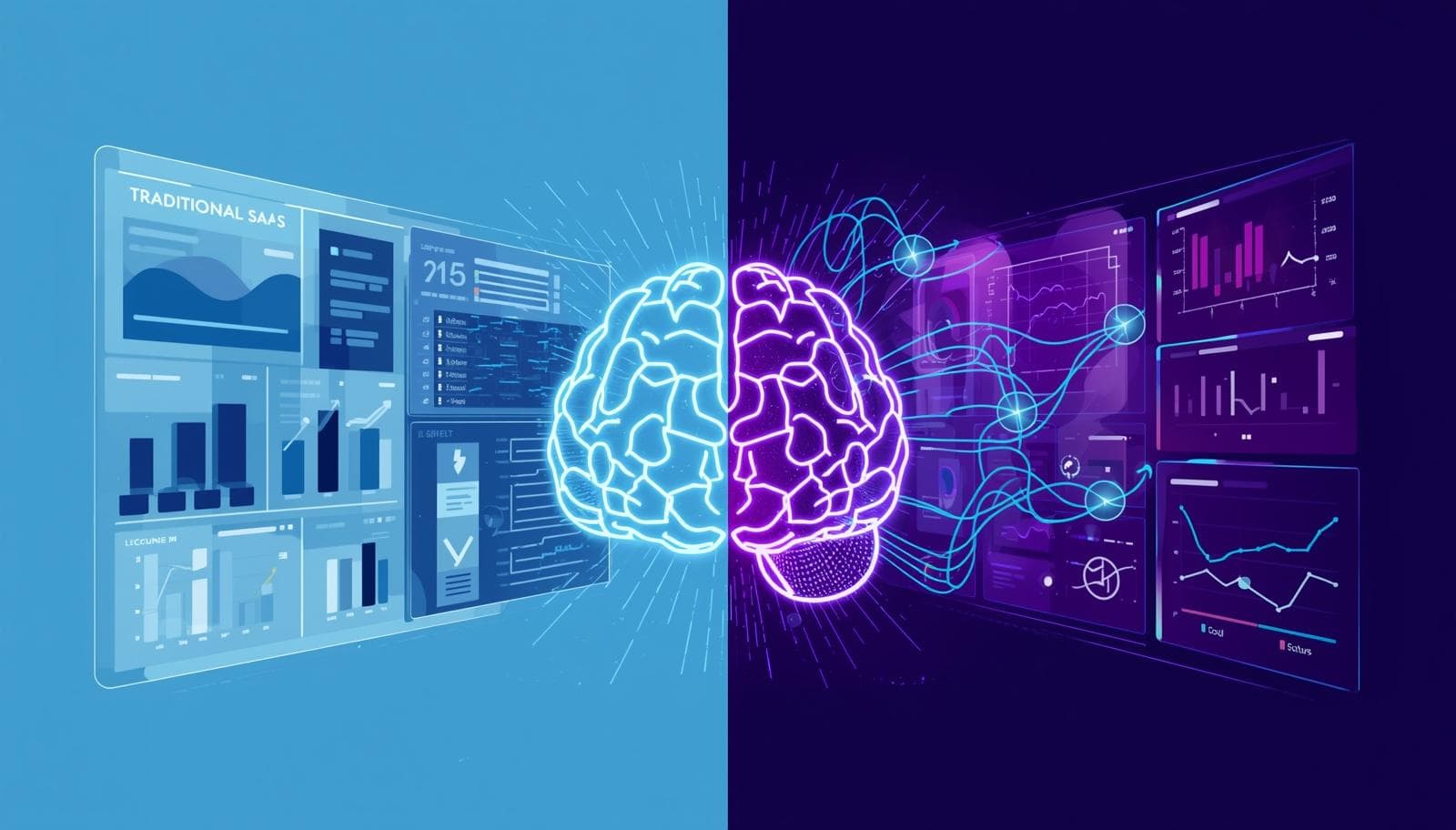
You’ve probably noticed that every software company suddenly has ‘AI powered’ in its tagline. Some of it is legitimate; some of it is just marketing fluff. But the thing is AI SaaS isn’t just an upgrade anymore, it’s becoming the baseline for staying competitive. If you’re still relying purely on traditional SaaS, then let me give you a reality check: you’re definitely living under a rock.
Why AI SaaS Over Traditional SaaS?
Before you build AI SaaS, you might wonder is the AI layer worth the extra complexity? Here's the honest breakdown:
| Factor | Traditional SaaS | AI-Powered SaaS |
|---|---|---|
| User Value | Static features, manual workflows | Adaptive, learns from user behavior |
| Differentiation | Compete on features & price | Compete on intelligence & outcomes |
| Gross Margins | 70-90% (predictable) | 30-50% (API costs vary with usage) |
| Development Speed | Faster initial build | Slower setup, but faster iterations with AI tools |
| Moat Potential | Low easy to copy features | High data compounds into defensibility |
| User Retention | Depends on switching costs | Higher personalization creates stickiness |
| Scalability | Linear cost scaling | Non-linear AI handles more without proportional headcount |
| Market Timing | Mature, crowded categories | Early mover advantage still available |
The trade-off is real. AI SaaS has tighter margins and more complexity upfront. But the defensibility and user value? definetly a Game changer. Traditional SaaS in 2026 is like a knife fight in a crowded room, while AI SaaS still has open territory.
How AI SaaS Actually Transforms Operations
AI SaaS platforms use machine learning to handle complexity that would overwhelm traditional systems. They process unstructured data, customer conversations, social media posts, voice calls and extract actionable insights automatically. Where AI SaaS becomes indispensable:
Intelligent automation that handles exceptions and edge cases without breaking Predictive analytics that forecast trends before they're obvious in your dashboards Hyper-personalization that tailors experiences to individual users in real-time Proactive problem-solving where the system identifies and fixes issues before they impact customers.
TBH,the companies I've seen scale fastest are the ones that embraced AI early. Reason: AI handles the grunt work while their teams focus on strategy and growth.
You can Actually Build AI SaaS for Under $5K
Yes. But only if you're ruthless about scope.
To have more information about MVP you can checkout what is MVP?
Industry data from 2026 shows simple MVPs cost $10K-$50K, with AI features adding 15-30% more. Those numbers assume building from scratch at agency rates. You don't have to do that.
What actually kills budgets?
- Custom model training (skip it)
- pixel-perfect design (not yet)
- features nobody asked for(hell no)
Tech Stack Is Boring And That’s the Point
Founders sometimes ask us, “Can we use X because it’s more future-proof?”, Future proofing before validation is how budgets die.
A 2026 AI SaaS MVP stack looks like this:
- Frontend that loads fast and doesn’t fight you
- Backend that plays nicely with AI APIs
- Auth + DB you don’t have to babysit
(Next.js, Node.js, supabase, postgress fits perfect)
Nothing exotic. Nothing experimental.choosing something new is not a good choice everytime. If it feels boring, I'm preety sure you’re doing it right.
Gartner predicts 80% of enterprise apps will embed GenAI by 2026. Founders who ship in the next six months have massive advantages over those still perfecting pitch decks in 2027.
So what are you building? And when are you shipping it? :/
AI SaaS Changes Everything

- Sales and marketing: AI analyzes your entire customer database to identify buying patterns you'd never spot manually. It predicts which leads will convert, suggests the perfect time to reach out, and even generates personalized outreach messages that actually sound human. Your sales team stops guessing and starts closing.
- Drift qualifies leads and books meetings automatically through AI conversations
- Gong analyzes sales calls to identify winning messaging patterns
- Customer experience: AI-powered chatbots handle 70-80% of routine inquiries instantly, while intelligently escalating complex issues to the right team member with full context. Your customers get faster resolutions, your team handles only the interesting problems.
- Zendesk's AI predicts customer needs and routes tickets to the best-suited agents
- Intercom reduces response times by 50-60% with intelligent automation
- Operations and analytics: Instead of spending hours building reports, AI tools automatically surface insights that matter. They'll alert you when metrics trend unexpectedly, explain why patterns are emerging, and recommend specific actions based on what's worked for similar companies.
- Tableau detects data anomalies automatically and explains probable causes
- Looker's AI identifies trends and suggests actions based on historical patterns
- Content and creative work: AI SaaS tools now generate first drafts, optimize headlines, suggest improvements, and even A/B test variations automatically. You're not replacing creativity you're amplifying it and moving way faster.
- Jasper generates brand-aligned content that helps teams produce 3-4x more output
- Copy.ai creates ad variations and email campaigns based on performance data
FAQs
1. What’s the biggest risk of building AI SaaS instead of traditional SaaS?
Margin compression. Your API costs scale with usage, so a viral product can actually hurt you if pricing isn’t dialed in. Validate unit economics early not after you’ve scaled.
2. Can I start with traditional SaaS and add AI later?
Yes, but it’s harder than it sounds. Retrofitting AI often means re-architecting your data layer. If AI is your endgame, design your data collection and storage with that in mind from day one.
3. Do I need ML expertise to build an AI SaaS MVP?
Not anymore. Pre-trained models via APIs (OpenAI, Anthropic, etc.) handle the heavy lifting. What you need is strong product sense and solid integration skills not a PhD.
4. How do I price AI SaaS when my costs are variable?
Usage-based or hybrid pricing works best. Charge based on value delivered (queries answered, documents processed) rather than flat subscriptions. Always build in margin buffers for API cost fluctuations.
5. What’s the minimum viable AI feature worth shipping?
One that saves users time on a repetitive, painful task. Don’t build “AI for AI’s sake.”
If you can’t articulate the time or money saved in one sentence, rethink the feature.
6. How do I compete if bigger players add the same AI features?
Niche down hard. Enterprise players move slowly and build generic solutions. Your advantage is speed, specificity, and obsessive focus on a single user persona’s workflow.
Conclusion
you need to internalize: the window is closing faster than you realize. By late 2026, the tooling will be commoditized, the playbooks will be public, and differentiation will require either deep proprietary data or serious capital.our unfair advantage right now isn't technology. It's speed and the willingness to ship something imperfect while everyone else is still researching.So stop optimizing your stack. Stop waiting for the perfect co-founder. Ship the ugly version. The market will teach you everything the research never will