In-House vs. Outsource MVP: 2026 Comparison for Founders


Do you spend the next four months trying to recruit a "rockstar" CTO and a couple of senior devs who want half your equity? Or do you wire cash to an agency you’ve never met, cross your fingers, and pray they don’t hand you a pile of spaghetti code three months from now?
Both paths are minefields. One burns your cash; the other burns your patience. The trick isn't finding the perfect path; it's knowing which potential disaster you're better equipped to handle.
Let’s tear down the "In house team vs outsource MVP" debate and look at what actually happens when the rubber meets the road.
In-House Development
We all have the same fantasy. A garage (or a WeWork). Three brilliant engineers who finish each other's sentences. Pizza boxes. Whiteboards covered in architecture diagrams that will change the world.
When it works, it’s magic. I’ve seen in-house teams pivot an entire product strategy over a lunch break. You can’t put a price tag on that kind of agility.
Pros
- Speed of Thought: You’re not writing Jira tickets; you’re tapping someone on the shoulder.
- The "Care" Factor: Your employee worries about the product at 10 PM on a Sunday. An agency dev is logging off at 5:00:01 PM.
- IP Paranoia: The code is yours. The bugs are yours. The genius is yours.
Cons
- Recruitment Lag: Hiring takes 3-4 months. Your runway burns while you wait for people to start.
- High Fixed Costs: You pay salaries even if the product fails. According to Robert Half's 2026 Tech Salary Guide, senior developers command $120K-180K annually. Plus, you're giving away 1-5% equity upfront—standard for early-stage CTOs.
- The Bad Hire: Hiring the wrong "senior" dev can set you back 6 months—2 to realize it, 1 to fire, and 3 to replace.
Outsourcing MVP
"Just outsource it to an agency!"
Sounds great. Low risk, right? If you hate them, fire them. No heavy salaries, no equity conversations. Just a monthly invoice and code on demand.
But outsourcing isn't a vending machine where you put in money and get out an app. It’s more like hiring a contractor to renovate your kitchen while you’re living in a different continent.
Pros
- Instant On: You sign the contract on Tuesday; the kick-off call is Thursday. Speed is the ultimate weapon for startups.
- Rental Expertise: Need a Kafka expert for two weeks? An agency has one on the bench. You don’t need to hire a full-time specialist for a temp job.
- The "Bus Factor": If an agency dev quits, the agency replaces them. If your sole in-house dev quits, your product dies until you rehire.
Cons
- The "Yes" Men: Bad agencies will say "yes" to every feature request because they bill by the hour. Good product managers say "no." If you don’t have a strong internal product owner, you will build a bloated, expensive mess.
- Code Quality Roulette: You might get a clean, scalable codebase. Or you might get a house of cards that collapses the moment 100 users log in. And unlike in-house teams, you often won't know until it's too late.
- Communication Lag: "I’ll fix that" means "I’ll fix that tomorrow." Those 24-hour delays compound. A 10-minute fix can take three days of email tag.
Comparison Matrix
Let's look at the trade-offs without the fluff.
| The Factor | In-House Team | Outsourced Dev |
|---|---|---|
| First Line of Code | Month 4 (Optimistic) | Week 2 |
| Cash Burn | High + Fixed ($150K+/dev/year) | Variable (Flexible) |
| Control Freak Level | High (Micromanage away!) | Low (Trust falls required) |
| Equity Cost | High (1–5% early on) | Zero |
| Quality Risk | You see it daily | "Black Box" risk |
| Post-MVP Life | Seamless | Handoff headaches |
4 Key Factors for Decision Making
Forget the pros and cons lists. Look at your specific situation. This is your decision tree.
1. The "Runway vs. Burn" Math
Do you have $1M in the bank? Congratulations, hire in-house. Build the culture. Are you bootstrapping or running on a generic "friends and family" round? Is it cheaper to outsource an MVP? Almost always, yes purely because you turn off the tap when you’re done. You can’t "pause" an employee’s salary.
2. How Weird is Your Tech?
Are you building a standard SaaS marketplace? Outsource it. It’s been done 1,000 times. Are you building a proprietary AI model involving bleeding-edge chaotic neural networks? Build in-house. Do not outsource your core IP innovation to a generalist shop.
3. The Investor Optics
Series A investors love in-house teams. It shows commitment. It shows you can recruit. If you walk into a pitch meeting with an outsourced product, be ready to explain how you plan to bring it in-house fast.
4. The "Hair on Fire" Index
Do you need to launch for a specific event in 3 months? Outsource. You physically cannot hire a team fast enough.
The Hybrid Approach
Smart founders often cheat the system. They use Staff Augmentation, a hybrid model that combines in-house leadership with outsourced execution.
You hire one key internal person, a CTO or a Lead Architect. This person is the "brain." Then, you surround them with outsourced "arms and legs" to do the heavy lifting.
- Why it wins: Your Lead ensures code quality and architecture (IP protection). The agency provides the sheer volume of coding hours.
- The Bonus: When you raise money, you already have your technical leader to hire the permanent team.
The 3-Month Rule
Here is a rule I give to founders who are stuck: If you cannot find a technical co-founder in 3 months, you MUST atleast start outsource.
I’ve seen founders wait a year looking for their "Wozniak." In that year, they built nothing. They learned nothing. They have zero users. A mediocre MVP built by an agency is infinitely more valuable than a perfect team that doesn't exist yet. Get the product out. Break things. Use the traction to attract the CTO later.
The Reality: Overhead, Costs, & Transition
Outsourcing is not hands-off. You’ll spend ~5 hours/week managing the agency—checking builds and clarifying specs. That's your "sanity rate" cost.
The Hidden Price Tags:
- In-House: Employment taxes, hardware, and severance if you pivot.
- Outsourcing: "Change Orders" for every scope creep and the eventual "Code Audit" when you hire a CTO.
Post-MVP Strategy: Post-MVP Strategy: Once you launch, move from Project Mindset to Product Mindset. Don't fire the agency immediately. Start hiring junior devs (check Robert Half's salary benchmarks for fair rates) to handle bugs while the agency wraps up heavy lifting, then transition fully. Don't fire the agency immediately. Start hiring junior devs to handle bugs while the agency wraps up heavy lifting, then transition fully.
Decision Scorecard
Give yourself points. Be honest.
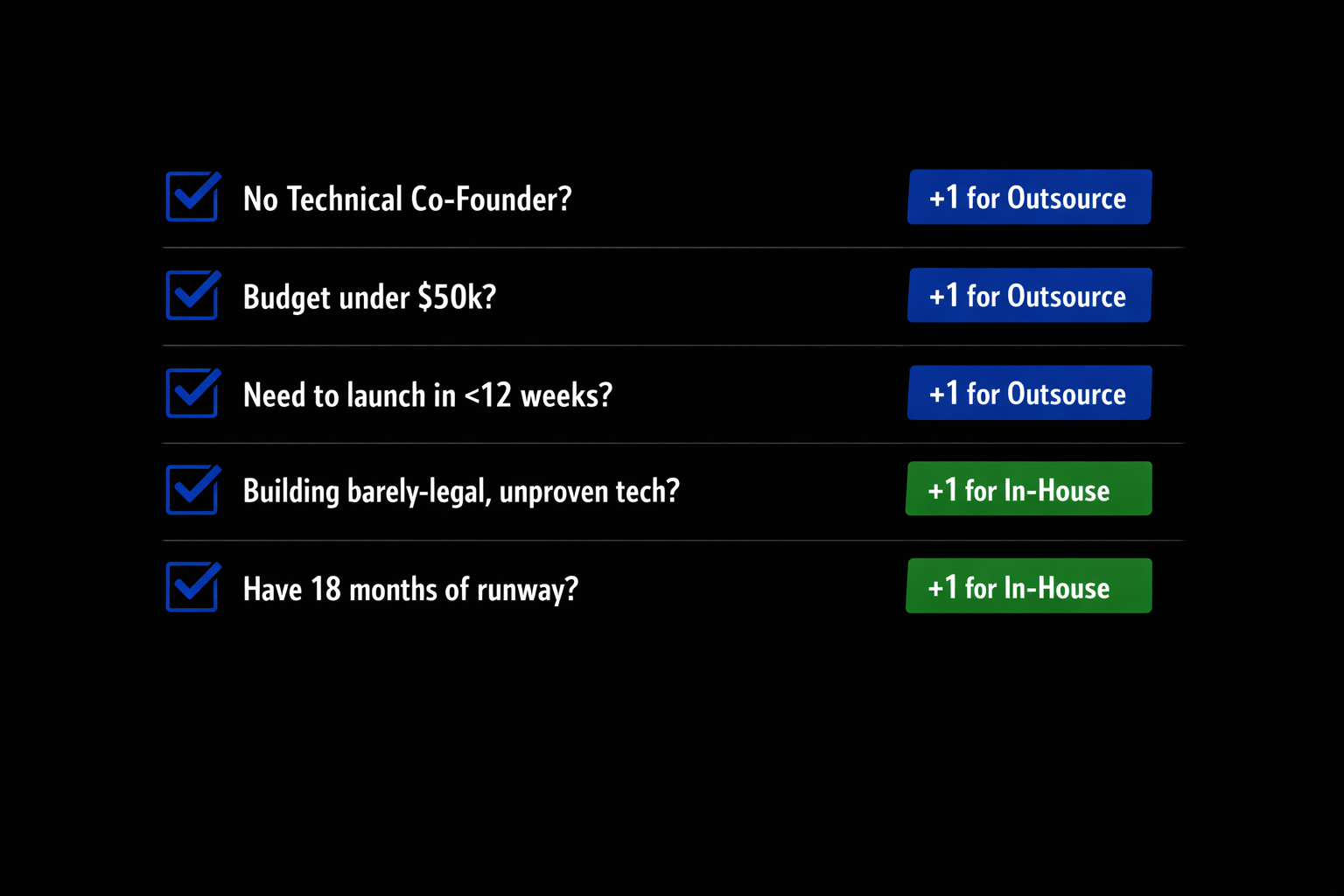
Result: Most early-stage startups should outsource or use the hybrid model. It’s not because it’s "better", it’s because it keeps you alive long enough to figure out if anyone actually wants your product.
Final Verdict
Don't let "best practices" kill your startup. I’ve seen unicorns built by agencies. I’ve seen burned-out craters left by "dream teams" who spent all their money on ergonomic chairs and zero time on customers.
Pick the path that buys you the most survival time. That’s it. That’s the whole strategy. Now, stop reading and go build the thing.