What is a Minimum Viable Product(MVP)?


An MVP is the simplest version of your product that solves a real problem for real people. That's it. No fancy features, no bells and whistles, just the core functionality that makes someone go, "Yeah, I'd actually use this."
Eric Ries, who basically made this concept famous in his Lean Startup methodology, describes it as the version of a new product that allows a team to collect the maximum amount of validated learning about customers with the least effort. Notice he didn't say "build the coolest thing possible" or "add every feature you can think of."
Uber's initial app only worked in San Francisco, only on iPhones, and only connected to black cars. These weren't feature-complete platforms. They were focused solutions to specific problems, built on foundations that could evolve.
That evolution matters. The code Airbnb wrote in 2008 grew into a system handling 7 million listings across 220 countries. Custom code compounds. Platform limitations don't.
Why MVPs Matter More Than Business Plan
Look, building products is expensive. Time, money, mental energy it all adds up fast. An MVP lets you validate your idea without betting the entire farm on it.
tell me : would you rather spend six months and $100k building something only to discover nobody wants it? Or would you rather spend four weeks and $10k testing if there's actual demand?
The importance of MVP development goes beyond just saving money. You're essentially buying insurance for your startup. According to CB Insights research, 35% of startups fail because there's no market need. An MVP helps you figure out if you're building something people actually want before you're in too deep.
MVPs help you:
- Test your core hypothesis without massive investment
- Get real user feedback early (not just from your circle who always say yes to everything)
- Pivot quickly if something's not working
- Attract early adopters who can become your biggest advocates
- Show potential investors cause you're not just talking you're executing
Companies like Dropbox, Airbnb, and Zappos all started with MVPs. Dropbox literally launched with just a video showing how the product would work. No actual product yet. Just a video. And they got 75,000 signups overnight.
The Big MVP Misconception

Too many founders think MVP means "cheap and crappy version of my product." Wrong. Dead wrong. You messed up.
The "move fast and break things" crowd misses: minimum viable doesn't mean minimum quality, and it will never.
An MVP is all about building something minimal but still viable. That second word matters. Your MVP needs to actually solve a problem and provide value. Otherwise, you're just testing whether people will use garbage software (let me give you spoiler: they won't).
MVP / Prototype / POC ? : don't mess up here, they're Not the Same Thing.
Linear's co-founder Tuomas Artman put it directly: "The MVP as a practice of building a hacky product as quickly and cheaply as possible to validate the product does no longer work. Many product categories are already saturated with a variety of alternatives, and to truly test the viability of any new idea you need to build something that is substantially better."
Zoom didn't invent video calling. Slack didn't invent team messaging. Spotify didn't invent music streaming. They won through execution quality and that required custom architecture from the start.
Linear identified three non-negotiables that demanded custom code: the app had to be fast (local data storage, no page reloads, offline availability), modern (keyboard shortcuts, command menus, contextual navigation), and multiplayer (real-time sync with teammate presence). No existing platform delivered all three.
The Build-Measure-Learn Loop (Your New Best Friend)
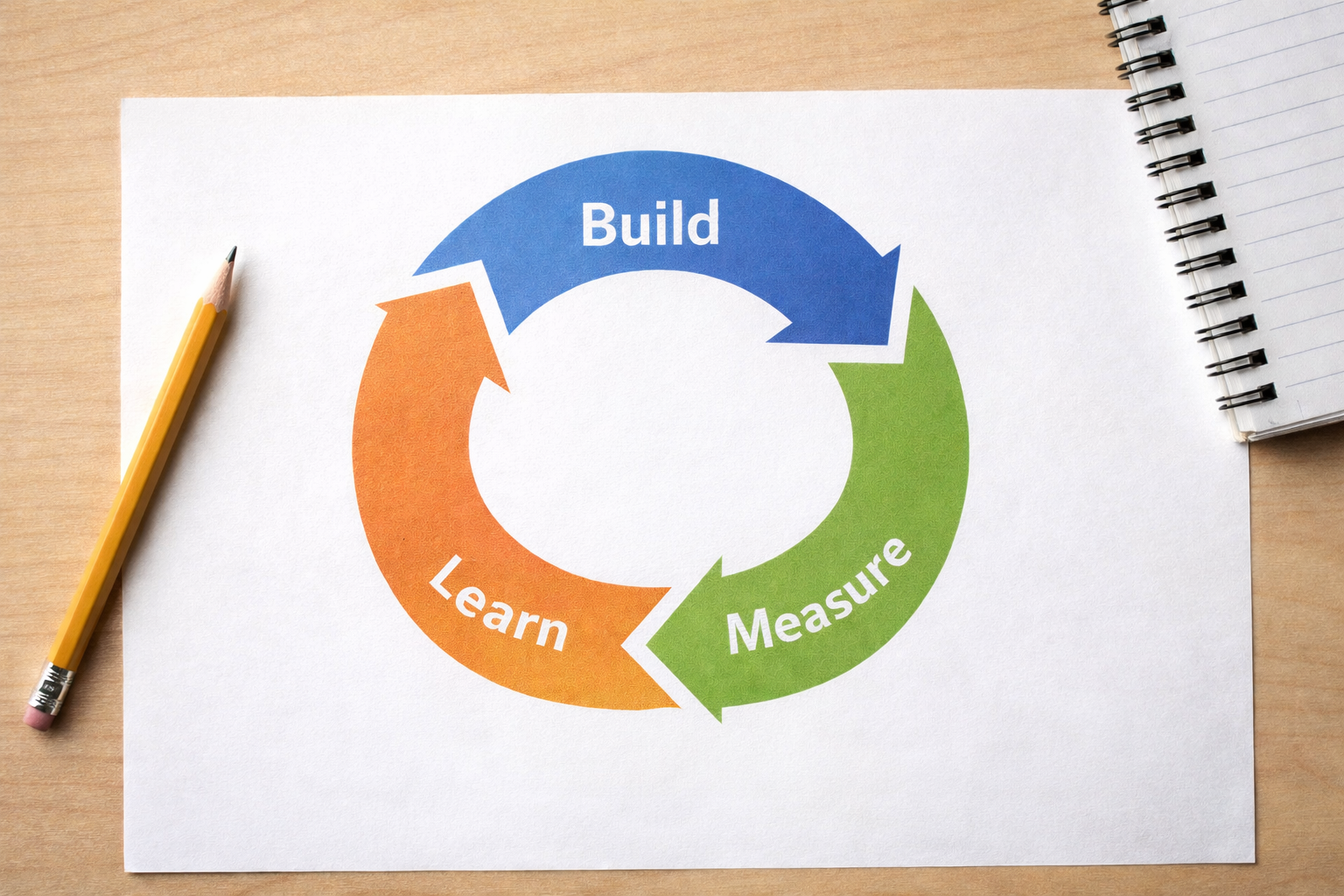
Build the simplest version that tests your hypothesis.
Focus ruthlessly on the core problem you're solving. Cut everything else. This phase typically involves sprint planning, agile development practices, and constant prioritization. The MVP development methodology here is all about speed and focus.
Measure how users interact with it. And I mean really measure not just downloads or signups, but actual usage patterns, retention, engagement. The numbers that actually matter.
Learn from the data and user feedback. What's working? What's confusing? What features do people beg for versus what they ignore?
Then you iterate. Build again, measure again, learn again.
Successful MVP Examples That Prove This Stuff Works
Some MVP examples from successful startups that actually made it.
Airbnb started with the founders renting out air mattresses in their apartment during a design conference in San Francisco. They built a simple site, posted some photos, and validated that people would actually pay to stay in strangers' homes. Their MVP was literally three air mattresses and a basic website. Now they're worth billions.
Dropbox created a 3-minute explainer video showing how file syncing would work. That video went viral and generated 75,000 signups before they had a working product. Why? Because it solved a real pain point people were experiencing.
Amazon started by selling only books. Jeff Bezos didn't try to be "the everything store" from day one. He validated the online retail model with one category first.
“The best MVP is the one that gets your idea in front of users fastest,
not the one that sounds most impressive at networking events.”
Common MVP Mistakes and Pitfalls
- Overbuilding
- Ignoring user feedback
- Choosing the wrong metrics
- Building for everyone
- Skipping validation entirely.
- Not having a clear hypothesis
- Choosing the wrong MVP type.
MVP Development Timeline

Week 1-2: Discovery and Planning
Define your core features, map user flows, validate assumptions with potential users. This includes competitive analysis, user interviews, and creating a lean feature specification. Don't skip this phase.
Week 3-5: Development Sprint
Build the actual product, focusing only on must-have features. This is where agile methodology for MVP development really shines. Daily standups, two-week sprints, continuous integration.
Week 6-7: Testing and Refinement
Fix bugs, smooth rough edges, prepare for launch. This includes QA testing, user acceptance testing with beta users, and performance optimization.
Week 8: Launch and Iterate
Soft launch to early adopters, gather feedback, iterate based on real user data.
Can you go faster? Absolutely. Some MVPs launch in 2-3 weeks if you're using no-code tools. Can it take longer? Sure, but ask yourself why.
The truth about MVP development duration? Most founders underestimate planning time and overestimate development time. Proper upfront planning can reduce overall development time by 30-40%.
Finding the Right Development Partner for Your MVP
Look, not everyone can or should build their own MVP. If you're not technical, trying to learn to code while also running a business is... ambitious. Sometimes you need help.
At Innew, we specialize in building Minimum Lovable Products (MLPs) and MVPs for founders who need to move fast. Our 30-day delivery model keeps projects focused and costs predictable. Whether you need a landing page MVP or a full single-feature MVP, we help you validate your idea without the overhead of a full development team.
Conclusion :
The startups that succeed aren't always the ones with the best ideas. They're usually the ones that learn fastest and adapt accordingly. And that starts with building an MVP the right way, minimal enough to launch quickly, viable enough to provide real value. Most importantly? It lets you fail fast and cheap instead of slow and expensive, Your MVP is your reality check. It means making tough decisions, cutting features you probably love, and launching something that feels incomplete. But that discomfort is exactly the point. Now stop overthinking and start building. You'll learn more in those days than in months of hypothetical conversations :)